Super Bear Adventure Puzzle Guide, How to Solve Every Type
Platforming and combat get most of the attention in Super Bear Adventure, but a good chunk of its secrets, golden bears, and bonus rewards sit behind puzzles instead of jumps. Unlike boss fights, which mostly reward reflexes, puzzles reward paying attention, since the solution is almost always hinted at somewhere nearby if you know what to look for.
Rather than walking through one puzzle at a time the way a lot of guides do, this one groups every super bear adventure puzzle by type, so once you understand the logic behind a switch puzzle or an electricity puzzle, you can solve every version of it you run into, no matter which world it shows up in. If all you needed was how to solve super bear adventure puzzle content in one specific spot, use the headings below to jump straight to the type you are stuck on.
A good number of these puzzles guard content that also shows up in our broader look at secret locations and hidden areas, so the two guides work well read side by side.
Why Puzzles Are Worth Solving
Skipping a puzzle usually means skipping whatever sits behind it, which is often a golden bear, a secret sticker, or a locked door that leads somewhere you cannot reach any other way. Golden bears in particular tend to reward more than a standard rescue, which makes the handful of minutes a tricky puzzle costs you a reasonable trade.
Switch Puzzles
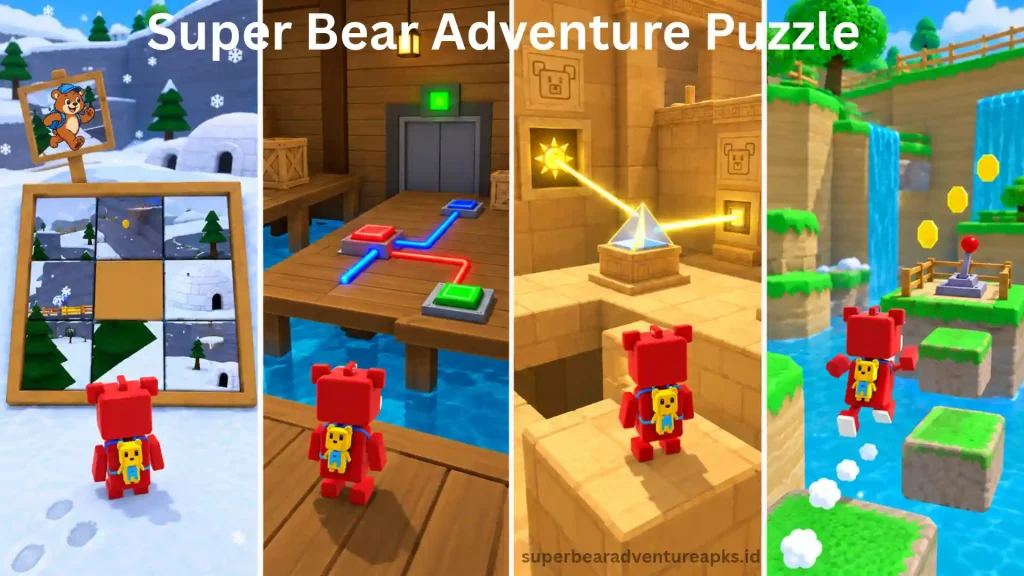
Switch puzzles ask you to activate a set of switches in a specific order rather than all at once. Hitting them out of sequence typically resets the whole puzzle rather than just undoing your last move, which is the main reason these feel harder than they actually are.
Color Pattern Puzzles
Color pattern puzzles use a sequence of colored blocks or lights that need to be activated in a specific order, similar in spirit to a memory game. The pattern is usually shown briefly before you need to repeat it, or displayed somewhere in the room for reference while you work through it.
Electricity Puzzles
Electricity puzzles ask you to reconnect broken wires or circuits to restore power to something, usually an elevator or a locked door. The best known version of this is the Giant House puzzle, where reconnecting the circuit is what reopens the path forward. The logic is closer to a simple wiring diagram than a timing challenge, which makes it one of the more relaxed puzzle types once you see the full layout.
The Pyramid and Temple Puzzles in Beemothep Desert
The desert world leans harder into puzzle solving than any other area, with sand dial mechanisms, light based puzzles, and maze like temple layouts packed into the Astral Temple. These tend to combine more than one puzzle type at once, so patience matters more here than anywhere else in the game.
Parkour and Puzzle Combos
Some sections blend platforming directly into the puzzle itself, asking you to jump and climb your way to levers or switches within a time limit. These fail less often because of the puzzle logic and more because of the platforming execution, so slow down and treat each jump as its own small challenge rather than rushing the whole sequence.
General Tips That Apply to Every Puzzle Type
Scan the room fully before interacting with anything. Nearly every puzzle in the game hides its solution somewhere nearby rather than expecting you to guess blindly.
Frequently Asked Questions
Conclusion
Every super bear adventure puzzle you run into really comes down to a small set of core ideas, switch sequences, color patterns, electrical circuits, and temple mechanisms, repeated and combined in different ways across the six worlds. Once you can recognize which type you are looking at, solving it becomes a matter of reading the room rather than guessing blindly. Slow down, look for the visual clue the game almost always leaves nearby, and most puzzles will take far less time to solve than they first appear to.